Why Dashain is celebrated
Dashain celebrates the victory of good over evil. Two great victories stand behind it.
The first comes from the Devi Mahatmya (Durga Saptashati), part of the Markandeya Purana. The buffalo demon Mahishasur had won a boon that no man or god could kill him. Drunk on that power, he drove the gods out of heaven. The gods joined their divine energies, and from that light rose the goddess Durga. She fought the demons for nine days and nights, and on the tenth day she killed Mahishasur.
The second victory is Lord Ram's. Before his final battle with Ravan in Lanka, Ram is believed to have worshipped the goddess Durga to seek her blessing. With her grace, he defeated Ravan on the tenth day, Vijaya Dashami.
So for fifteen days, from Ghatasthapana to Kojagrat Purnima, Nepali families worship the goddess, gather together, and receive tika and blessings from their elders. Here is the story, day by day.
Ghatasthapana: the goddess is invited home
Long ago, heaven lay empty. Mahishasur sat on Indra's throne, and the gods wandered the earth like exiles. In despair, they went to Brahma, Vishnu and Shiva. As they told their story, a blazing light poured out of each god's anger. The lights flowed together into one dazzling form: the goddess Durga, with many arms, each holding a weapon gifted by a god. Shiva gave his trident, Vishnu his discus, Indra his thunderbolt, and the Himalaya gave her a lion to ride.
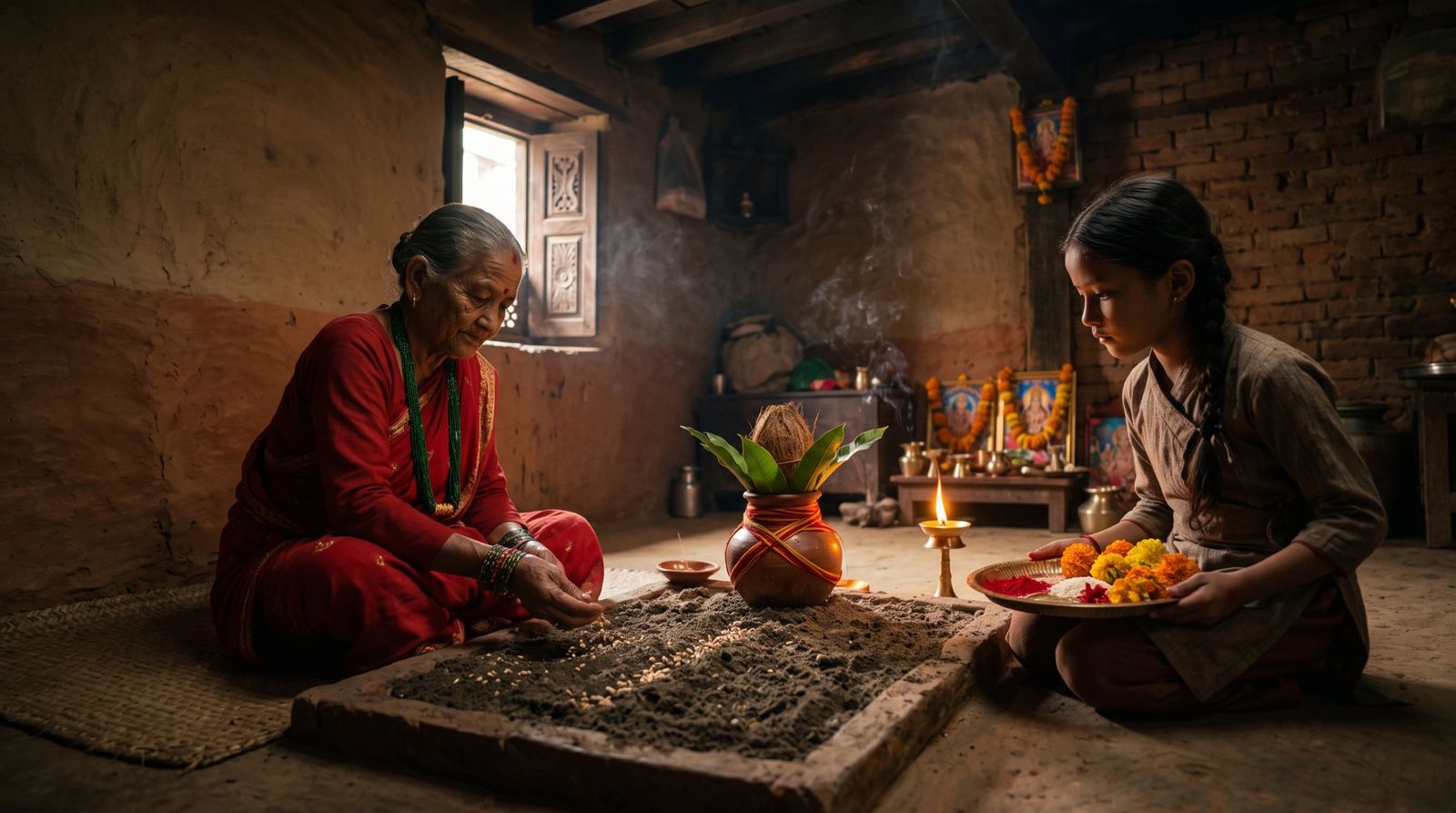
On this first day, every Nepali home welcomes that goddess. In the dashain ghar, a room kept clean and closed to outsiders, the family fills a kalash with holy water and sets it on a bed of sand and earth. Into that earth they sow barley and maize. The kalash becomes the seat of Durga, and the family prays: “Mother, come and stay with us.”
The goddess is worshipped this day as Shailaputri, daughter of the mountain. For nine days the seeds are watered and kept from sunlight, and they grow into golden-yellow jamara, the goddess's own blessing.
Navaratri: the goddess rides to battle
When Mahishasur heard that a goddess had come to challenge him, he laughed. He sent his generals and armies against her, one after another. Durga rode out on her lion, and the battle began. It would last nine days and nights.
Each day of Navaratri, devotees worship a different form of the goddess, as if watching her strength unfold:
The goddess of devotion and self-discipline, who once performed long penance to win Shiva. She teaches that real strength begins with a steady mind.
She wears a half-moon shaped like a bell on her forehead. When she rings it in battle, the demons tremble.
With a gentle smile, it is said, she created the universe out of darkness. She is the light that warms all life.
The mother of Kartikeya, commander of the gods' army. She is both a loving mother and a fierce protector.
Born in the ashram of the sage Katyayan, she is the warrior form who goes straight out to face Mahishasur.
At home, the family lights a diyo before the kalash each morning, offers flowers and recites the Durga Saptashati. Every day the jamara grows a little taller, a sign that the goddess is present and her blessing is growing.
Fulpati: the sacred flowers arrive
On the seventh day the battle grows fierce, and the goddess is worshipped as Kalaratri, her dark, fearsome form that destroys all darkness and fear.
In Nepal this day has a story of its own. In the time of the Shah kings, the royal family's kuldevata was in Gorkha. When the capital moved to Kathmandu, Dashain stayed tied to Gorkha. So every year on Saptami, priests carry a sacred bundle called fulpati from Gorkha to Kathmandu: a kalash wrapped in red cloth, with leaves, flowers, banana stalk, jamara and sugarcane, each holding part of the goddess's blessing.
When the fulpati reaches Kathmandu, it is welcomed with a grand parade at Tundikhel and carried into Hanuman Dhoka Durbar as soldiers fire salutes. Across the country, families bring fulpati into their own dashain ghar. From this day many people return home from the cities and abroad, and the real feeling of Dashain fills every house.
Maha Ashtami: Kali and the demon of a thousand drops
As the war raged on, the demons sent their most terrifying warrior: Raktabija. He carried a dreadful boon. Every drop of his blood that touched the ground rose up as another Raktabija. Each time Durga struck him, a hundred new demons sprang from the earth, until the battlefield was crowded with copies of him.
Then Durga's face darkened with fury, and from her brow burst Kali, black as the night sky, with a garland of skulls and a tongue that stretched across the field. As Durga struck Raktabija, Kali spread her tongue wide and drank every drop of his blood before it could touch the ground. No new demons could rise. At last Raktabija fell, and the battlefield was quiet.
That is why Ashtami honours the goddess's most powerful forms. By day she is worshipped as Mahagauri, radiant and pure, and the night of Ashtami is called Kalratri, the dark night, when worship of Kali reaches its height in the temples. Some devotees offer sacrifices, while many offer pumpkins, coconuts or fruit instead. Families also worship young girls as kumari, living forms of the goddess.
Maha Navami: the final battle
With his armies destroyed, Mahishasur came himself. He was a shape-shifter. He charged as a giant buffalo, shaking the mountains with his horns. When Durga's lion attacked, he became a lion. When she raised her sword, he became a man with a sword. When she struck, he grew into a huge elephant. Then he took his buffalo form again, roaring across the battlefield.
Durga drank divine nectar, laughed, and said: “Roar while you can, foolish one. Soon the gods will roar with joy instead.” She leapt onto the buffalo and pressed him down with her foot. As Mahishasur tried to escape from the buffalo's mouth in his true form, she cut him down with her sword. The long war was over.
Navami honours the goddess as Siddhidatri, giver of all powers and success. It is also the day of Vishwakarma puja: people worship their vehicles, tools, machines and weapons, and ask the goddess to keep them safe all year. In Kathmandu, the doors of the Taleju Bhawani temple at Hanuman Dhoka open to the public on this one day each year.
Vijaya Dashami: the day of victory
On the tenth morning, the sun rose over a world set free. The gods returned to heaven, flowers fell from the sky, and the whole universe sang the goddess's praise. Durga blessed them all: “Whenever evil rises again, remember me, and I will come.”
Far away, on this same day, another battle ended. In Lanka, Lord Ram, blessed by the goddess, fought the ten-headed Ravan. Every time he cut off one of Ravan's heads, another grew back. At last, guided by Vibhishan, Ram aimed his arrow at the nectar hidden in Ravan's navel, and the demon king fell. Sita was free, and dharma had won. That is why the day is called Vijaya Dashami, the tenth day of victory.
In every Nepali home the kalash is worshipped one last time, and the family gathers in their best clothes. At the auspicious saait, elders place red tika of rice, curd and abir on the foreheads of the younger ones, tuck golden jamara behind their ears, and bless them with long life, wisdom, success and prosperity. The younger ones bow and receive dakshina. The red of the tika is said to be the colour of the goddess's power, and the jamara her blessing grown over nine days. Then come laughter, feasting, and the long round of visiting relatives.
Kojagrat Purnima: who is awake?
After Vijaya Dashami, Dashain does not end at once. For the next five days families travel from house to house, to grandparents, uncles, aunts and in-laws, receiving tika and blessings from every elder. Swings (ping) sway in the villages, kites fill the sky, and old quarrels are forgotten. Dashain becomes a festival of bringing people back together.
On the fifteenth day comes the full moon, Kojagrat Purnima. An old belief says that on this night the goddess Laxmi, giver of wealth, travels the earth under the bright moon, asking at every door: “Ko jagrat?” Who is awake?
She blesses the homes where people are awake, the lamps are lit and hearts are clean. So families worship Laxmi, keep the lights burning, and stay up through the night singing and playing. With Laxmi's blessing and the full moon shining, the fifteen days of Dashain come to a close, until the goddess is invited home again next year.
Jai Bhagawati! Jai Durga Bhawani! May the goddess's blessing stay with every family, wherever home is.
दशैं किन मनाइन्छ?
दशैं असत्यमाथि सत्यको विजयको पर्व हो। यसका पछाडि दुई ठूला विजयका कथा छन्।
पहिलो कथा मार्कण्डेय पुराणको देवी माहात्म्य (दुर्गा सप्तशती) बाट आउँछ। महिषासुर नामको राक्षसले कुनै पुरुष वा देवताले मार्न नसक्ने वरदान पाएको थियो। त्यही शक्तिको घमण्डमा उसले देवताहरूलाई स्वर्गबाट धपायो। देवताहरूले आफ्ना दिव्य शक्ति एकै ठाउँ मिलाए, र त्यो तेजबाट देवी दुर्गा प्रकट हुनुभयो। उहाँले नौ दिन र नौ रात राक्षसहरूसँग युद्ध गर्नुभयो र दसौं दिन महिषासुरको वध गर्नुभयो।
दोस्रो विजय भगवान् रामको हो। लंकामा रावणसँगको अन्तिम युद्धअघि रामले देवी दुर्गाको आराधना गरी आशीर्वाद मागेको विश्वास छ। देवीको कृपाले उहाँले दसौं दिन, विजया दशमीमा, रावणलाई पराजित गर्नुभयो।
त्यसैले घटस्थापनादेखि कोजाग्रत पूर्णिमासम्म पन्ध्र दिन नेपाली परिवारहरू देवीको पूजा गर्छन्, एकै ठाउँ भेला हुन्छन्, र ठूलाबडाबाट टीका र आशीर्वाद थाप्छन्। यहाँ दिनदिनैको कथा छ।
घटस्थापना: देवीलाई घरमा निम्तो
धेरै पहिले स्वर्ग सुनसान थियो। महिषासुर इन्द्रको सिंहासनमा बसेको थियो, र देवताहरू निर्वासितझैं पृथ्वीमा भौँतारिरहेका थिए। निराश भएर उनीहरू ब्रह्मा, विष्णु र महेश्वरकहाँ पुगे। आफ्नो दुःख सुनाउँदा हरेक देवताको क्रोधबाट प्रचण्ड तेज निस्कियो। ती तेज मिलेर एउटै चम्किलो रूप बन्यो: अनेक हात भएकी देवी दुर्गा, जसका हरेक हातमा देवताहरूले दिएका अस्त्र थिए। शिवले त्रिशूल, विष्णुले सुदर्शन चक्र, इन्द्रले वज्र दिए, र हिमालयले उहाँलाई चढ्न सिंह दिए।
यस पहिलो दिन हरेक नेपाली घरले ती देवीलाई स्वागत गर्छ। बाहिरका मानिसलाई प्रवेश नदिई सफा राखिएको दशैंघरमा परिवारले कलशमा पवित्र जल भरेर बालुवा र माटोमाथि राख्छ। त्यो माटोमा जौ र मकैका बिउ छरिन्छ। कलश देवी दुर्गाको आसन बन्छ, र परिवार प्रार्थना गर्छ: "आमा, आउनुहोस्, हामीसँगै बस्नुहोस्।"
यस दिन देवीको शैलपुत्री, अर्थात् पर्वतकी छोरीका रूपमा पूजा गरिन्छ। अबका नौ दिन बिउमा पानी हालिन्छ र घामबाट जोगाइन्छ, अनि ती सुनौलो पहेँलो जमरा बनेर उम्रन्छन्, जुन देवीको आफ्नै आशीर्वाद हो।
नवरात्र: देवी युद्धमा
देवी आफूलाई चुनौती दिन आएको सुनेर महिषासुर हाँस्यो। उसले आफ्ना सेनापति र सेना एकपछि अर्को गर्दै देवीविरुद्ध पठायो। दुर्गा सिंहमा चढेर निस्कनुभयो, र युद्ध सुरु भयो, जुन नौ दिन र नौ रातसम्म चल्नेवाला थियो।
नवरात्रको हरेक दिन भक्तहरू देवीको फरक रूपको पूजा गर्छन्, मानौं उहाँको शक्ति बिस्तारै प्रकट हुँदैछ:
भक्ति र संयमकी देवी, जसले शिवलाई पाउन लामो तपस्या गर्नुभएको थियो। उहाँ सिकाउनुहुन्छ कि साँचो शक्ति स्थिर मनबाट सुरु हुन्छ।
उहाँको निधारमा घण्टीको आकारको अर्धचन्द्र छ। युद्धमा उहाँले त्यो बजाउँदा राक्षसहरू थरथर काँप्छन्।
उहाँले आफ्नो मन्द मुस्कानले अन्धकारबाट ब्रह्माण्ड सृष्टि गर्नुभएको भनिन्छ। उहाँ सबै जीवलाई न्यानो दिने ज्योति हुनुहुन्छ।
देवताहरूको सेनापति कार्तिकेयकी आमा। उहाँ मायालु आमा पनि हुनुहुन्छ र उग्र रक्षक पनि।
ऋषि कात्यायनको आश्रममा जन्मनुभएकी, उहाँ महिषासुरको सामना गर्न सिधै जाने योद्धा रूप हुनुहुन्छ।
घरमा परिवारले हरेक बिहान कलशअगाडि दियो बाल्छ, फूल चढाउँछ, र दुर्गा सप्तशतीको पाठ गर्छ। जमरा हरेक दिन अलिअलि बढ्दै जान्छ, जुन देवी उपस्थित हुनुहुन्छ र उहाँको आशीर्वाद बढ्दैछ भन्ने संकेत हो।
फूलपाती: पवित्र फूलपातीको आगमन
सातौं दिन युद्ध झन् भयानक हुन्छ, र देवीको कालरात्रि रूपको पूजा गरिन्छ, जुन सबै अन्धकार र डर नाश गर्ने उग्र रूप हो।
नेपालमा यस दिनको आफ्नै कथा छ। शाह राजाहरूको समयमा राजपरिवारका कुलदेवता गोरखामा थिए। राजधानी काठमाडौं सरेपछि पनि दशैंको परम्परा गोरखासँग जोडिइरह्यो। त्यसैले हरेक वर्ष सप्तमीका दिन पुजारीहरूले फूलपाती नामको पवित्र पोको गोरखाबाट काठमाडौं ल्याउँछन्। रातो कपडाले बेरिएको कलशभित्र पात, फूल, केराको थाम, जमरा र उखु हुन्छन्, जसमा देवीको आशीर्वादको अंश हुन्छ।
फूलपाती काठमाडौं आइपुगेपछि टुँडिखेलमा भव्य स्वागत गरिन्छ र सैनिकहरूले सलामी दिँदै हनुमानढोका दरबार भित्र्याइन्छ। देशभरि परिवारहरूले पनि आफ्नो दशैंघरमा फूलपाती भित्र्याउँछन्। यही दिनदेखि धेरै मानिस सहर र विदेशबाट घर फर्कन्छन्, र हरेक घरमा दशैंको साँचो रौनक छाउँछ।
महाअष्टमी: काली र रक्तबीज
युद्ध चल्दै जाँदा राक्षसहरूले आफ्नो सबैभन्दा डरलाग्दो योद्धा पठाए: रक्तबीज। उसले भयानक वरदान पाएको थियो। उसको रगतको हरेक थोपा जमिनमा खस्नासाथ अर्को रक्तबीज उठ्थ्यो। दुर्गाका अस्त्रले उसलाई हान्दा जमिनबाट सयौं नयाँ राक्षस निस्किन्थे, र रणभूमि उसकै प्रतिरूपले भरियो।
तब दुर्गाको अनुहार क्रोधले कालो भयो, र उहाँको निधारबाट काली प्रकट हुनुभयो: रातको आकाशझैं कालो, मुण्डमाला लगाएकी, र रणभूमिभरि फैलिने जिब्रो भएकी। दुर्गाले रक्तबीजलाई प्रहार गर्दा कालीले जिब्रो फैलाएर उसको रगतको हरेक थोपा जमिनमा पर्नुअघि नै पिउनुभयो। अब नयाँ राक्षस उठ्न सकेनन्। अन्ततः रक्तबीज ढल्यो, र रणभूमि शान्त भयो।
त्यसैले अष्टमीमा देवीका सबैभन्दा शक्तिशाली रूपको सम्मान गरिन्छ। दिनमा उहाँको उज्यालो र पवित्र महागौरी रूपको पूजा गरिन्छ, र अष्टमीको रातलाई कालरात्रि भनिन्छ, जब मन्दिरहरूमा कालीको पूजा चरम हुन्छ। केही भक्तहरू देवीलाई बलि चढाउँछन्, भने धेरैले कुभिन्डो, नरिवल वा फलफूल चढाउँछन्। परिवारहरूले साना केटीहरूलाई देवीकै जीवित रूप मानेर कुमारी पूजा पनि गर्छन्।
महानवमी: अन्तिम युद्ध
सेना सखाप भएपछि महिषासुर आफैं आयो। ऊ रूप फेर्न सक्थ्यो। ऊ विशाल राँगा बनेर सिङले पहाड हल्लाउँदै झम्टियो। देवीको सिंहले आक्रमण गर्दा ऊ सिंह बन्यो। देवीले तरवार उठाउँदा ऊ तरवार बोकेको मानिस बन्यो। प्रहार गर्दा ऊ ठूलो हात्ती बन्यो। फेरि ऊ राँगाकै रूपमा फर्केर रणभूमिभरि गर्जियो।
दुर्गाले दिव्य अमृत पिउनुभयो, हाँस्नुभयो र भन्नुभयो: "मूर्ख, जबसम्म सक्छस् गर्जिले। चाँडै तेरो सट्टा देवताहरू खुसीले गर्जनेछन्।" उहाँ उफ्रेर राँगामाथि चढ्नुभयो र खुट्टाले थिच्नुभयो। महिषासुर आफ्नो वास्तविक रूपमा राँगाको मुखबाट निस्कन खोज्दा उहाँले तरवारले उसको वध गर्नुभयो। लामो युद्ध सकियो।
नवमीमा देवीको सिद्धिदात्री, अर्थात् सबै सिद्धि र सफलता दिने रूपको पूजा गरिन्छ। यो दिन विश्वकर्मा पूजाको पनि हो: मानिसहरू आफ्ना सवारी साधन, औजार, मेसिन र हतियारको पूजा गर्छन्, र वर्षभरि सुरक्षाको कामना गर्छन्। काठमाडौंमा हनुमानढोकाको तलेजु भवानी मन्दिरको ढोका वर्षमा यही एक दिन आम भक्तजनका लागि खुल्छ।
विजया दशमी: विजयको दिन
दसौं बिहान, मुक्त भएको संसारमाथि सूर्य उदायो। देवताहरू स्वर्ग फर्के, आकाशबाट फूल बर्सियो, र सारा ब्रह्माण्डले देवीको स्तुति गायो। दुर्गाले सबैलाई आशीर्वाद दिनुभयो: "जब जब फेरि अधर्म बढ्छ, मलाई सम्झ, म आउनेछु।"
टाढा, यही दिन अर्को युद्ध पनि सकियो। लंकामा देवीको आशीर्वाद पाएका भगवान् रामले दशानन रावणसँग युद्ध गर्नुभयो। रावणको एउटा टाउको काट्दा अर्को उम्रन्थ्यो। अन्ततः विभीषणको सल्लाहमा रामले रावणको नाभिमा लुकेको अमृतमा बाण हान्नुभयो, र राक्षसराज ढल्यो। सीता मुक्त हुनुभयो, र धर्मको जित भयो। त्यसैले यो दिनलाई विजया दशमी, अर्थात् विजयको दसौं दिन भनिन्छ।
हरेक नेपाली घरमा अन्तिम पटक कलशको पूजा गरिन्छ, र परिवार राम्रा लुगा लगाएर भेला हुन्छ। शुभ साइतमा ठूलाबडाले अक्षता, दही र अबिर मुछेको रातो टीका साना सदस्यको निधारमा लगाइदिन्छन्, कानमा सुनौलो जमरा सिउरिदिन्छन्, र दीर्घायु, बुद्धि, सफलता र समृद्धिको आशीर्वाद दिन्छन्। साना सदस्यहरू ढोग्छन् र ठूलाबडाबाट दक्षिणा थाप्छन्। टीकाको रातो रङ देवीको शक्तिको रङ र जमरा नौ दिनमा उम्रेको उहाँको आशीर्वाद मानिन्छ। त्यसपछि हाँसो, भोज, र आफन्तकहाँ टीका थाप्न जाने लामो यात्रा सुरु हुन्छ।
कोजाग्रत पूर्णिमा: को जाग्रत?
विजया दशमीपछि दशैं तुरुन्तै सकिँदैन। अबका पाँच दिन परिवारहरू हजुरबा-हजुरआमा, काका-काकी, मामा-माइजू र ससुराली गर्दै घरघर पुगेर हरेक ठूलाबडाबाट टीका र आशीर्वाद थाप्छन्। गाउँमा पिङ मच्चिन्छ, आकाशमा चङ्गा उड्छन्, र पुराना मनमुटाव बिर्सिन्छन्। दशैं मानिसलाई फेरि जोड्ने पर्व बन्छ।
पन्ध्रौं दिन पूर्णिमा आउँछ, कोजाग्रत पूर्णिमा। पुरानो विश्वासअनुसार यो रात धनकी देवी लक्ष्मी उज्यालो जूनमुनि पृथ्वी घुम्दै हरेक ढोकामा सोध्नुहुन्छ: "को जाग्रत?" अर्थात्, को जागा छ?
जुन घरमा मानिस जागा छन्, बत्ती बलेको छ र मन सफा छ, उहाँ त्यही घरलाई आशीर्वाद दिनुहुन्छ। त्यसैले परिवारहरू लक्ष्मीको पूजा गर्छन्, बत्ती बालिराख्छन्, र गीत गाउँदै, खेल्दै रातभर जाग्छन्। लक्ष्मीको आशीर्वाद र पूर्णिमाको जूनसँगै पन्ध्र दिनको दशैं सकिन्छ, अर्को वर्ष फेरि देवीलाई घरमा निम्तो नदिएसम्म।
जय भगवती! जय दुर्गा भवानी! देवीको आशीर्वाद हरेक परिवारमा रहोस्, घर जहाँ भए पनि।